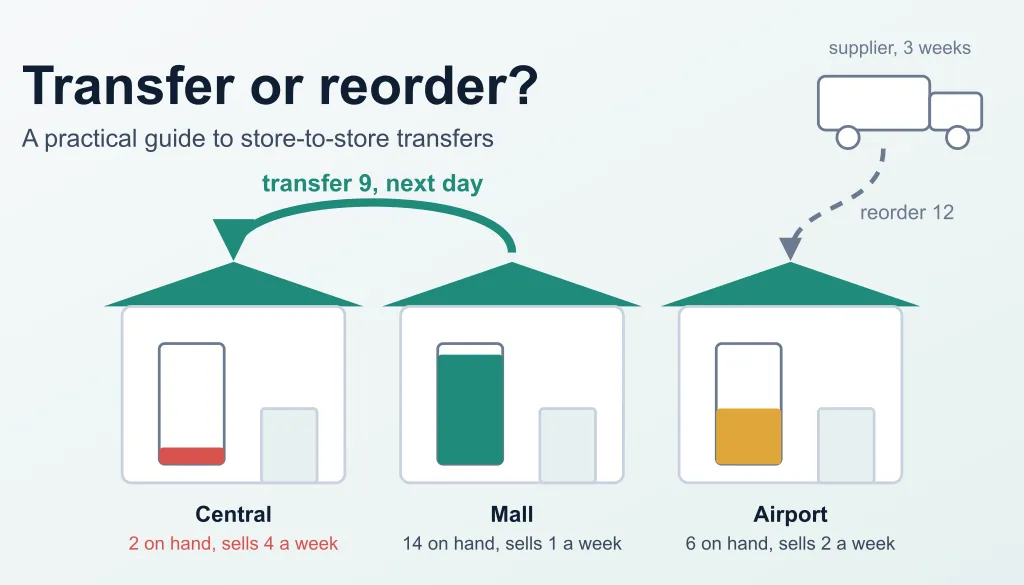
Transfer or reorder? A practical guide to store-to-store transfers
Who this is for: demand planners, inventory managers and buyers who run more than one store and keep landing on the same Monday morning question. One store is about to sell out of something that another store can't sell. Do you move it, or do you order more?
My honest answer is "both, in a particular order", and the order matters more than most people think. A store to store transfer is the fastest way to recover sales you'd otherwise lose. It also doesn't add a single unit to your network. Only the purchase order does that. Below is a decision rule you can run by hand this week and automate later, the thresholds that stop it from misfiring, a three-store example you can recompute on a napkin, and the mistakes I see most often once a retailer starts rebalancing inventory between stores.
Transfer order vs purchase order: two different decisions
Both documents move stock. That is about where the similarity ends.
| Purchase order | Transfer order | |
|---|---|---|
| What it does | Buys stock from a supplier and adds it to the network | Moves stock you already own from one location to another |
| Network total | Goes up | Unchanged |
| Cost | Purchase price, cash tied up, supplier minimums | Transport, handling at both ends, shrink and damage in transit |
| Time to shelf | Supplier lead time, often weeks | Days, sometimes hours |
| Question it answers | "Do we have enough in total?" | "Is what we have in the right place?" |
There is a second confusion hiding inside the ERP, because two very different movements share one document type. A warehouse-to-store transfer is replenishment: the goods arrived centrally and you are allocating them. A store-to-store transfer is rebalancing: the allocation turned out to be wrong, or demand went somewhere you didn't expect, and now you are correcting it. This article is about the second kind. The first one simply follows your normal replenishment logic, and the only extra question is how much to hold back at the warehouse.
When a transfer beats a reorder: the decision rule
A transfer is worth making when three things are true at once. Not two. All three.
- The target store will run out before a reorder could arrive. Compare its expected demand over the supplier lead time plus your review period with what it has on hand and on order.
- Another store holds more than it needs over that same horizon. Not "has stock". Has stock beyond its own forecast, its safety stock and whatever it needs on display.
- The margin you recover is worth more than the move. Units moved times unit margin, counting only the units the target will realistically sell before the next delivery, minus transport, handling and the odd damaged box.
Written as a rule, with one horizon shared by every store:
Protect period = supplier lead time + review period
Need at target = forecast × protect period + safety stock − on hand − on order
Surplus at source = on hand + on order − (forecast × protect period + safety stock)
Transfer quantity = min(need at target, surplus at source), if it clears the minimum quantity and the margin floor
Reorder = whatever need is left across all stores after the transfer
The protect period is the bit people get wrong, and they get it wrong in the same direction every time. It has to be the horizon of the reorder, not the horizon of the transfer. If a purchase order takes three weeks to land and you order weekly, every store needs four weeks of cover protected. A source store with two weeks of cover has no surplus at all, no matter how full the shelf looks when you walk past it.
Thresholds that keep the rule honest
Run the rule naked on every SKU and every pair of stores and you will get hundreds of one-unit transfers, several of them in opposite directions. Planners switch a tool off for good after one list like that, and I don't blame them. These thresholds are the difference between a rebalancing policy and noise. Treat the starting values as a first week, then tune them against what your planners actually reject.
| Threshold | Starting value | What it prevents |
|---|---|---|
| Minimum transfer quantity | 3 units or one inner pack, whichever is larger | Lines whose handling cost exceeds the margin of the units moved |
| Cover gap | Target cover below the protect period, source cover above twice the protect period | Moving the stockout from one store to another |
| Source floor | Never below forecast × protect period + safety stock, and never below the display minimum | Emptying the shelf that sells the product in the source store |
| Margin floor | Recovered margin at least 5 × the cost of the move, and at least a fixed amount per line (we start at 20 EUR) | Transfers that are technically positive and practically pointless |
| Cooldown | No reverse transfer of the same SKU on the same lane for 4 weeks | Ping-pong between two stores whose forecasts wobble |
| Lane and cadence | Only on lanes you actually run (van routes, courier contracts), batched to the lane's schedule | Ad-hoc courier costs and transfers nobody picks |
| Lifecycle override | Clearance and discontinued items consolidate into the fastest-selling store, ignoring the surplus rule | Dead stock sitting in six stores instead of selling in one |
The cover gap deserves its own paragraph. Asking the source to hold twice the protect period looks conservative, and it is, but it is the single rule that stops a transfer from creating the next transfer. If your forecast is decent at store level you can bring it down to 1.5 × after a couple of months. If your forecast is weekly at network level and then split by a fixed store share (more common than anyone admits), leave it at 2 × and fix the forecast first.
A three-store worked example
One product, three stores, one supplier. Lead time is 3 weeks and you order weekly, so the protect period is 4 weeks. Safety stock is half a week of demand, rounded up. A weekly van connects all three stores at 0.40 EUR per unit moved. Unit margin is 25 EUR, minimum transfer quantity is 3. The numbers are small on purpose, so you can check them.
Inputs
| Store | On hand | On order | Forecast per week | Weeks of cover | Safety stock |
|---|---|---|---|---|---|
| Central | 2 | 0 | 4.0 | 0.5 | 2 |
| Mall | 14 | 0 | 1.0 | 14.0 | 1 |
| Airport | 6 | 0 | 2.0 | 3.0 | 1 |
Step 1: need and surplus over the protect period
| Store | Keep (forecast × 4 + safety) | On hand + on order | Need | Surplus |
|---|---|---|---|---|
| Central | 4.0 × 4 + 2 = 18 | 2 | 16 | 0 |
| Mall | 1.0 × 4 + 1 = 5 | 14 | 0 | 9 |
| Airport | 2.0 × 4 + 1 = 9 | 6 | 3 | 0 |
Airport looks healthy with 3 weeks of cover. It isn't. The protect period is 4 weeks, so Airport is short too, by 3 units, and it has nothing to give. A rule that looked at "weeks of cover above two" would have raided it. That rule exists in more ERPs than you would think.
Step 2: the transfer
Central needs 16, Mall can spare 9. Transfer = min(16, 9) = 9, which clears the minimum of 3. The move costs 9 × 0.40 = 3.60 EUR. Will Central actually sell those 9 units before the purchase order lands? At 4 a week they are gone in a little over two weeks, well inside the 3.5 weeks it would otherwise spend with an empty shelf. Recovered margin 9 × 25 = 225 EUR, net 221.40 EUR. The floor isn't even close.
Now check the source after the move. Mall keeps 5 units, which is its full protect-period keep. The 9 units it gave away would have sat there for 9 weeks. At Central they will be gone in just over 2.
Step 3: the reorder, which does not go away
| Store | After transfer | Keep | Still short |
|---|---|---|---|
| Central | 11 | 18 | 7 |
| Mall | 5 | 5 | 0 |
| Airport | 6 | 9 | 3 |
| Network | 22 | 32 | 10 |
Ten units are still missing across the network and no transfer can create them. Order 10, round up to the supplier's pack of 6, so 12. Without the transfer the purchase order would have been 19 units, Central would have stood empty for three and a half weeks, and Mall would have kept 14 weeks of stock on the shelf. Same supplier, same shelf space, roughly 350 EUR of margin difference on one SKU, from one line on a van that was driving anyway. Multiply that by the number of SKUs you carry and you see why I keep going on about this.
The move the rule refuses
A planner looking at the screen might be tempted to send 3 units from Airport to Central. Airport has "plenty", Central is empty, the van is going anyway. The rule says no, because Airport has no surplus over the protect period. Those 3 units would sell at Central in under a week, and Airport would run dry around week 1.5, three weeks before its own reorder lands. That is a stockout relocated, not a stockout avoided. The right answer for Airport is the reorder, and maybe a phone call to the supplier.
Common mistakes when rebalancing inventory between stores
- Deciding on today's stock instead of forecast cover. Fourteen units at Mall is a surplus only because Mall sells one a week. The same 14 at Central is half a protect period. Every transfer rule has to start from a per-store forecast, and if you don't have one, build that first. Our explainer on how demand forecasting works covers what a store-level forecast needs.
- Counting transport but not handling. Somebody picks, packs, labels, receives and shelves every line, at both ends. Shrink and damage in transit are real, especially for apparel and anything fragile. Put a cost per line and a cost per unit into the margin floor and let the floor say no to the small stuff.
- Ping-pong transfers. Store A sends to B this week, B sends it back next week because a local promotion nudged B's forecast. The cooldown and the 2 × cover gap exist for exactly this. If you see the same SKU bouncing on the same lane, the forecast is the problem, not the rule.
- Moving the stockout. The Airport example above. Any rule that measures surplus against a shorter horizon than the reorder horizon will do this regularly, and it will look fine in the week it happens.
- Breaking size runs and packs. In fashion and footwear, pulling one size out of a run leaves the source with a broken curve that sells worse than the units you took. Rebalance at size level with the run's health in view, or move whole packs.
- Treating recurring transfers as a success. If the same product moves from the same source to the same target every month, your initial allocation or your store-level forecast is wrong. Transfers are the correction. The allocation is the fix.
- Mixing up rebalancing with replenishment. Warehouse-to-store transfers follow your reorder logic and belong in the same decision as the purchase orders. Apply the store-to-store surplus rule to a warehouse and the warehouse looks like an endless surplus, right up until it is empty.
- Forgetting ABC. A transfer of a C item rarely clears the margin floor, and that is fine. Run the rule on everything, but expect nearly all approved lines to be A and B items. If you don't segment yet, start with ABC analysis.
How planners should approve and adjust transfers
The rule produces a proposal list, not a decision. The part a system can't see is the part the planner adds, and that part is not small. A decent weekly routine looks like this:
- Sort by net recovered margin. The first ten lines usually hold most of the value. Review those properly, skim the rest.
- Check the source. Is the stock really there, and sellable? Damaged, reserved for a customer, screwed to a display fixture, part of the window? Reject, with a reason.
- Check the target. Does the forecast know about next week's event, the road works outside, the competitor opening across the street? Adjust the quantity rather than killing the line.
- Check the lane. Does the van actually run that day? Is the receiving store staffed to shelve the delivery? A transfer that sits in a back room for a week recovered nothing.
- Record every rejection reason. "Display stock", "damaged", "local promotion", "wrong size run". After a month the reasons tell you which threshold to change, and which data the forecast is missing.
Adjusting beats rejecting. If the proposal says 9 and the planner knows Mall has a school-uniform season starting, 6 is the right answer. Keep the line, change the number, keep the reason. Over time the share of lines approved without edits becomes the KPI of the whole process. Above 80 percent and the rule and the forecast have earned trust. Below 50 and the planners are doing the system's job by hand, which is the worst of both worlds. We wrote about pairing numbers like that so none of them lies alone in Inventory KPIs for Retail.
Where Catwing fits
Everything above hangs on one input most retailers don't have: a demand forecast per product and per store, refreshed as sales come in. That is what Catwing builds from your ERP data. It sets healthy stock levels for every product in every store and proposes the orders and transfers that keep you there. Planners get one list, sorted by what each line is worth, with the reasoning next to it, and approve, adjust or reject. The rejections feed back. If you would like to see the rule run on your own stores and your own products, that is a conversation we enjoy having.
Frequently asked questions
What is the difference between a transfer order and a purchase order?
A purchase order buys stock from a supplier and increases what the whole network owns. It costs cash and takes the supplier lead time. A transfer order moves stock you already own between two of your locations, so the network total doesn't change; it costs transport and handling and takes days.
When should you transfer stock between stores instead of reordering?
When the target store will run out before a reorder could arrive, another store holds more than it needs over the same horizon, and the margin you recover covers the move with room to spare. In practice you do both. The transfer bridges the lead time and the purchase order restores the network total.
How do you decide how much to transfer?
Take the smaller of the target's need and the source's surplus, both measured over the protect period (supplier lead time plus review period) and after safety stock. Then apply a minimum quantity, a margin floor and the source's display minimum. Round to packs if the product ships in packs.
Is a warehouse-to-store transfer order the same as a store-to-store transfer?
No. A warehouse-to-store transfer is replenishment of stock that arrived centrally and follows the reorder logic. A store-to-store transfer is rebalancing, a correction to an allocation that turned out wrong. They share an ERP document type and not much else.
How often should stores rebalance inventory?
On the cadence of the lane that carries the goods, which for most retailers means weekly, and always decided together with that week's purchase orders. More often than the lane runs is noise. Less often than the review period means the transfer arrives after the reorder would have.